
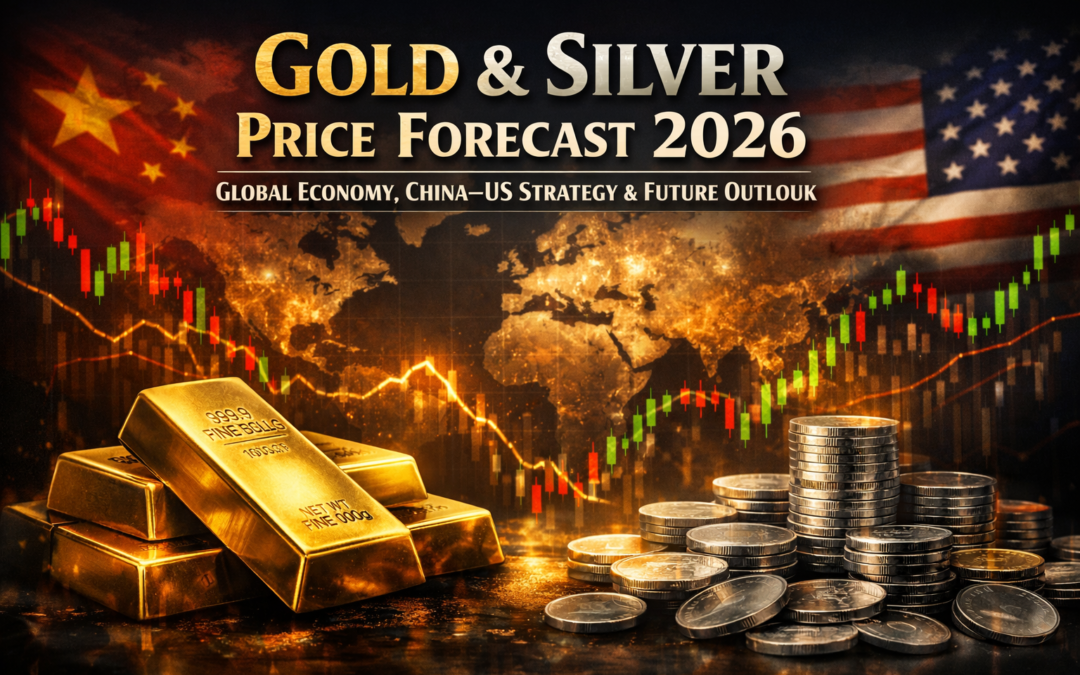
 Gold & Silver in the Global Economy: History, Crashes, Power Politics, and 2026 Price Outlook
Introduction: Why Gold and Silver Still Matter in a Changing World
Gold and silver are not just metals; they are economic signals. For thousands of years, civilizations have trusted these two assets as stores of value during uncertainty. Even in today’s digital world—dominated by fiat currencies, stock markets, and cryptocurrencies—gold and silver continue to play a critical role in how governments, central banks, investors, and industries protect wealth and manage risk.
However, many people misunderstand precious metals. They assume gold and silver only go up. History proves otherwise. These markets move in powerful cycles—long periods of accumulation, sharp rallies, brutal corrections, and then renewed strength. Understanding these cycles is essential, especially as the global economy enters a period of structural change.
This article explores:
- The historical crashes and rallies of gold and silver
- Why prices behave so violently
- How China and the United States strategically view precious metals
- How the global economy treats gold and silver today
- And most importantly, where gold and silver prices may head in 2026 and the months ahead
This is not hype, not fear-mongering, and not speculation without logic. This is a grounded, macro-economic, human-based analysis.
A Brief History of Gold and Silver Price Cycles
Silver 1980: The First Modern Wake-Up Call
In the late 1970s, inflation in the United States was spiraling out of control. Trust in paper currency was collapsing. During this chaos, silver
prices surge
d dramatically, driven by speculation and aggressive buying.
By early 1980, silver touched levels that shocked the world. But the rally was artificial. A small group of powerful investors attempted to dominate the market. When regulators changed trading rules and liquidity dried up, silver collapsed brutally—losing nearly 90% of its value in a short period.
Lesson:
Silver is extremely sensitive to speculation and leverage. When confidence disappears, prices fall much faster than they rise.
Gold and Silver 2011: Fear Peaks, Then Fades
The 2008 global financial crisis pushed gold and silver into another historic rally. Investors feared the collapse of banks, currencies, and governments. Gold reached record highs, and silver followed aggressively.
But by 2011–2012, panic began to fade. Central banks stabilized markets. Interest rates were controlled. Capital slowly returned to equities. As fear declined, precious metals entered a long correction phase.
Silver lost more than two-thirds of its value. Gold corrected heavily as well.
Lesson:
Gold and silver thrive on uncertainty—but they struggle when confidence returns to financial systems.
Why Gold and Silver Are Different Assets
Gold: Monetary Metal First, Commodity Second
Gold is primarily a monetary asset. Central banks hold it. Governments measure confidence in currencies against it. During inflation, currency debasement, or geopolitical conflict, gold acts as insurance.
Gold does not rely heavily on industrial demand. Its value comes from trust—or the loss of trust—in paper money.
Silver: Hybrid Metal with Extreme Volatility
Silver is different. It is both:
- A monetary metal
- And a critical industrial metal
Silver is used in electronics, solar panels, medical devices, electric vehicles, and advanced technologies. This dual role makes silver far more volatile than gold.
When economic growth is strong, silver benefits from industrial demand.
When fear dominates markets, silver rises with gold—but often faster.
When conditions reverse, silver falls harder.
The Global Economy Today: A System Under Stress
The global economy is no longer stable in the way it once was. Several long-term pressures are reshaping financial markets:
1. Record Global Debt
Governments around the world are carrying unprecedented levels of debt. Servicing this debt without inflation is becoming increasingly difficult.
2. Persistent Inflation Risk
Even when inflation slows, the underlying causes—energy costs, supply chain restructuring, and geopolitical tensions—remain unresolved.
3. Geopolitical Fragmentation
The world is shifting from globalization toward regional power blocs. Trade wars, sanctions, and currency competition are becoming normal.
In such an environment, gold and silver regain importance—not as speculative tools, but as financial anchors.
How the World Views Gold and Silver Today
Central Banks and Gold
Central banks—especially in Asia and emerging markets—are increasing gold reserves. This is not accidental. It reflects a desire to reduce dependence on the US dollar and protect national balance sheets from currency risk.
Gold is increasingly viewed as:
- A neutral reserve asset
- A hedge against currency weaponization
- A long-term store of sovereign value
Industrial Nations and Silver
Silver is now strategically important for energy transition goals. Solar power, electric mobility, and high-tech manufacturing all require silver.
Governments may not openly talk about silver reserves—but industrial policy reveals its importance.
Silver is no longer “just a metal.” It is infrastructure.
China’s
Strategy: Quiet Accumulation and Industrial Control
China does not broadcast its intentions—but its actions are clear.
1. Physical De
mand Focus
China consistently absorbs large amounts of physical gold and silver. Unlike Western markets, which focus on paper contracts, China emphasizes physical ownership.
2. Industrial Priority
Silver is critical for China’s solar and technology sectors. Controlling supply ensures long-term cost stability for domestic industries.
3. Strategic Patience
China does not chase short-term price spikes. It accumulates during weakness. This behavior supports long-term price floors.
China sees precious metals not as trading assets—but as strategic resources.
The United States’ Perspective: Dollar First, Metals Second
The US views gold and silver differently.
Dollar Dominance
The strength of the US dollar is central to American economic power. Gold rallies often signal weakening confidence in the dollar—something policymakers prefer to avoid.
Interest Rate Policy
When rates rise, gold and silver often face pressure. When rates fall or debt concerns rise, metals regain strength.
The US does not oppose gold, but it does not want gold to overshadow the dollar.
Paper Markets vs Physical Reality
One of the biggest misunderstandings about precious metals is price discovery.
Most global prices are determined in paper markets—futures, options, and derivatives. Physical demand often tells a different story.
When physical supply tightens while paper prices fall, it creates long-term imbalances. Historically, such imbalances eventually resolve through higher prices.
2026 Price Outlook: Gold and Silver Scenarios
Now the most important question: What happens next?
Gold Price Outlook (2026 and Coming Months)
Base Scenario:
Gold remains strong, holding above previous long-term averages. Central bank demand, geopolitical uncertainty, and debt concerns provide support.
Bullish Scenario:
If inflation resurfaces or geopolitical risks escalate, gold could push significantly higher as confidence in currencies weakens.
Bearish Scenario:
If interest rates stay high and global growth stabilizes, gold may consolidate or correct—but structural support remains strong.
Key Insight:
Gold is unlikely to return to old lows. The world has changed.
Silver Price Outlook (2026 and Coming Months)
Silver is more complex—and more explosive.
Base Scenario:
Industrial demand continues to grow steadily. Prices remain volatile but trend upward over time.
Bullish Scenario:
If investment demand joins industrial demand, silver could outperform gold dramatically. Historically, silver moves late—but violently.
Bearish Scenario:
Short-term corrections are possible, especially during strong dollar phases. But long-term downside appears limited due to supply constraints.
Key Insight:
Silver is high-risk, high-reward. It punishes emotional decisions—but rewards patience.
How Investors and Businesses Should Think
Gold and silver should not be viewed as “get-rich-quick” assets.
They are:
- Risk management tools
- Inflation hedges
- Long-term strategic holdings
For businesses—especially in jewelry and manufacturing—understanding cycles is critical for cost control and pricing strategy.
For investors, allocation and timing matter more than predictions.
A New Era for Precious Metals
As global markets continue to evolve, staying connected with real-time data and credible industry insights becomes more important than ever. Monitoring live price movements helps investors, traders, and jewelry professionals make informed decisions in a highly volatile environment. You can track real-time gold market activity through our Live Gold Trade page, which provides updated pricing and market direction. For deeper professional insights, industry analysis, and precious metals discussions, connect directly with Haroon Ahmed on LinkedIn and stay updated with expert perspectives on gold, silver, and the global precious metals economy.
Q2. What is the silver price prediction for 2026?
Silver price prediction for 2026 depends on industrial demand, supply deficits, and investment inflows. Silver is expected to remain more volatile than gold with higher upside potential.
Q3. Is gold a good investment in 2026?
Gold is considered a strong investment in 2026 due to rising global debt, inflation concerns, and its role as a safe-haven asset during economic uncertainty.
Q4. Is silver a better investment than gold in 2026?
Silver can outperform gold in bullish markets due to its industrial demand, but it also carries higher risk. Gold offers stability, while silver offers higher growth potential.
Q5. How does the global economy affect gold prices?
Gold prices rise during economic instability, inflation, or currency weakness, and tend to consolidate when interest rates rise or economic confidence improves.
Q6. Why is silver more volatile than gold?
Silver is more volatile because it is both a precious metal and an industrial metal, making its price sensitive to economic growth and manufacturing demand.
Q7. How does China influence gold and silver prices?
China influences gold and silver prices through physical demand, central bank gold accumulation, industrial consumption, and control over refining and supply chains.
Q8. What role does the US dollar play in gold and silver prices?
Gold and silver prices generally move inversely to the US dollar. A weaker dollar supports higher metal prices, while a stronger dollar puts pressure on prices.
Q9. Can gold and silver protect against inflation in 2026?
Gold and silver are commonly used as inflation hedges because they preserve purchasing power when fiat currencies lose value.
Q10. What are the main risks for gold and silver investors in 2026?
Key risks include rising interest rates, strong US dollar, reduced safe-haven demand, and short-term market volatility driven by speculation.